How to Achieve Mark-Free Bending in Sheet Metal Fabrication
May 23, 2026
Exploring Mark-Free Bending in Press Brake Workpieces
How to Achieve Mark-Free Bending in Sheet Metal Fabrication
The Solutions for No-Marking Press Brake Bending
In modern sheet metal fabrication, surface quality is becoming just as important as bending accuracy. Industries such as elevator manufacturing, kitchen equipment, architectural decoration, consumer electronics, and automotive interiors all require flawless surfaces without scratches, pressure marks, or die indentations.
However, traditional press brake bending often leaves visible bending marks on stainless steel, aluminum, coated sheets, mirror-finish metals, and painted materials. These defects increase rework costs and reduce product value.
To solve this problem and prevent bending marks on sheet metal, manufacturers are increasingly adopting advanced no mark press brake tooling solutions. This article explains the most effective methods for achieving flawless results while maintaining bending precision and productivity.
What Causes Bending Marks on Sheet Metal?
Before selecting a solution, it is important to understand why bending marks occur.
During the bending process, the sheet metal slides and presses against the V die surface under high pressure. Friction, concentrated force, and poor die surface conditions can create:
Scratches
Pressure lines
Surface indentation
Coating damage
Roller drag marks
These problems are especially visible on:
Mirror stainless steel
Brushed stainless steel
Aluminum sheets
Galvanized steel
Painted or coated materials
Decorative sheet metal panels
The key to mark-free bending is reducing friction and distributing pressure evenly during forming.
6 Professional Solutions for Mark-Free Bending
1. No-Mark Film and Tensioner Systems
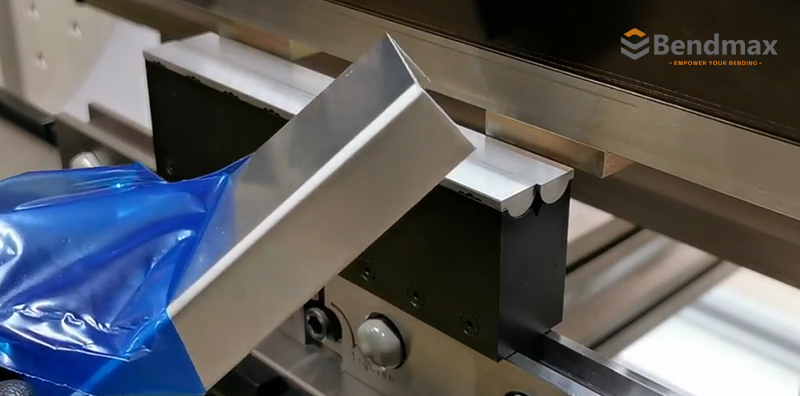
One of the simplest methods is using a protective no-mark film between the sheet metal and the lower die.
The film acts as a protective barrier that absorbs friction during bending and prevents direct metal-to-metal contact.
How It Works
A flexible protective foil is inserted between the workpiece and the V die. During bending, the film moves together with the sheet, reducing scratching and indentation.
Protective film for bending operations press brake
Protective Film Holder and Positioner
Key Features
Available in different thicknesses
Easy to install and replace
Low investment cost
Suitable for temporary protection
Advantages
Simple and economical
Compatible with most standard V dies
Effective for light cosmetic protection
Limitations
Film wears out quickly
Requires frequent replacement
May slightly affect angle accuracy in precision bending
Typical Applications
Decorative stainless steel panels
Brushed aluminum sheets
Light cosmetic components
2. No-Mark Rotary Dies / Wing-Bend Tools
Rotary bending dies are among the most advanced solutions for scratch-free bending.
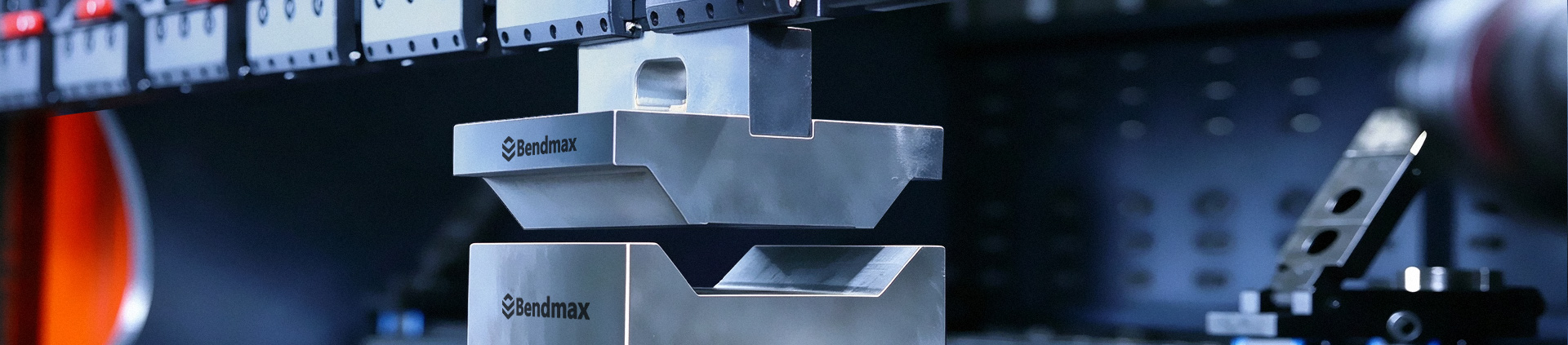
The use of Bendmax Rotabend bottom tools helps reduce marking because the hardened rotor wings rotate during bending instead of dragging across the sheet surface.
These dies feature a rotating flap mechanism in the lower die. As the punch presses the sheet into position, the flap rotates to maintain surface contact without sliding friction.
Key Points
Feature: Polished chrome surface (Ra ≤ 0.4 μm)
Advantage: Even force distribution with almost no surface dragging
Result: Virtually eliminates bending pressure marks
Advantages
Excellent cosmetic surface protection
Reduced friction during forming
Consistent bending angles
Suitable for automated production
Limitations
Higher initial cost than standard dies
Typical Applications
Stainless steel countertops
Elevator panels
Decorative architectural products
High-end appliance panels
Why Rotary Dies Work Better: Traditional V dies create sliding friction. Rotary dies convert sliding movement into rotational movement, significantly reducing surface damage.
3. Nylon Insert Press Brake Dies
Nylon insert no-mark dies use replaceable nylon materials embedded into the contact area of the lower die. Because nylon has high elasticity and a very low friction coefficient, it greatly reduces mechanical marks on the sheet surface.
Structure: The nylon insert maintains the same V opening geometry as standard steel dies while adding a softer contact surface.
Key Features
Replaceable nylon inserts
Same bending geometry as conventional V dies
Low-friction contact surface
Advantages
Excellent protection for sensitive surfaces
Lower tooling cost compared to full polyurethane systems
Easy maintenance through insert replacement
Limitations
Nylon inserts wear faster under heavy tonnage
Not ideal for very thick materials
Typical Applications
Stainless steel decoration
Coated sheet metal
Aluminum enclosure panels
4. Roller-Type Mark-Free Press Brake Tools
Roller-type no-mark (mark-free) dies / Free-mark dies with Roller inside use rotating hard alloy rollers integrated into the lower die.
As bending occurs, the rollers rotate synchronously with the sheet movement. This transforms sliding friction into rolling friction, dramatically reducing scratches and pressure marks.
Key Points
Feature: Rotating alloy rollers on contact surfaces
Advantage: Dynamic rolling contact
Best For: Ultra-thin sheets below 0.5 mm
Advantages
Extremely low friction
Excellent for precision bending
Protects delicate coatings and polished finishes
Improves consistency in thin-sheet forming
Limitations
Higher tooling cost
Requires maintenance for roller systems
Typical Applications
Precision electronics
Solar panel frames
Thin stainless steel covers
Consumer electronics housings
5. Polyurethane Insert Press Brake Tools
Polyurethane press brake tooling uses soft elastic inserts to cushion the sheet during bending. These inserts distribute bending pressure evenly and prevent direct hard-contact marking.
Soft contact inserts may be made from Polyurethane, Nylon, or Rubber-based materials. Polyurethane inserts are especially suitable for bending radiused profiles and delicate decorative materials.
Key Points
Feature: Polyurethane insert or spring ejector system
Advantage: Fully eliminates pressure marks
Result: Uniform bend radius with smooth surface quality
Advantages
Best surface protection among all no-mark solutions
Excellent for soft metals
Produces smooth and uniform bend radii
Limitations
Not suitable for thick heavy-gauge materials
Polyurethane inserts eventually deform under high tonnage
Typical Applications
High-gloss aluminum
Mirror-finish stainless steel
Smartphone frames
Decorative consumer products
6. Customized Mark-Free Press Brake Tooling
Custom wiping bending
Custom U channel bending
Custom channel bending
For complex geometries or highly sensitive surfaces, customized no-mark tooling is often the best solution.
These tools are specifically designed according to: material type, material thickness, bend radius, surface finish requirements, product geometry, and production volume.
Custom tooling can combine: rotary structures, polyurethane inserts, roller systems, special surface coatings, and multi-stage bending structures.
Advantages
Maximum surface protection
Optimized bending accuracy
Improved production efficiency
Best solution for complex applications
Typical Applications
Aerospace components
Premium architectural panels
Automotive decorative trims
High-end stainless steel fabrication
Main Advantages of Mark-Free Bending Tools
Modern no-mark press brake tooling offers significant benefits in manufacturing efficiency, quality control, and cost reduction.
1. Surface Protection
Prevents scratches, dents, and pressure marks on sensitive materials.
2. Reduced Rework and Scrap
Fewer surface defects mean lower rejection rates and more stable production quality.
3. Wide Material Compatibility
Suitable for:
Stainless steel, Aluminum, Galvanized steel
Painted sheets, Decorative metals
4. Longer Tool Life
Replaceable inserts extend the overall service life of the tooling system.
5. Higher Production Efficiency
Reduces the need for protective films and secondary polishing operations.
How to Choose the Right No-Mark Press Brake Tooling
Selecting the correct mark-free bending solution depends on several technical factors.
Surface Finish Requirements
Different finishes require different levels of protection (Mirror finish, Brushed finish, Painted surfaces, Coated materials). The more sensitive the surface, the softer and smoother the tooling contact must be.
Material Thickness and Strength
Thicker or high-strength materials require stronger insert systems to maintain angle precision. Soft insert systems may deform under excessive tonnage.
Bend Angle and V Opening
Proper matching between punch radius, V opening, material thickness, and bending angle is essential for maintaining bend consistency and preventing material deformation.
Part Geometry
Complex shapes such as deep boxes, large-radius bends, U-shaped profiles, and multi-step bends often require specialized no-mark tooling structures.
Production Volume & Budget
High-volume production favors durable rotary or roller systems.
Small-batch production may benefit from modular insert solutions.
Replaceable insert systems usually provide the best balance between initial tooling cost, maintenance expense, and long-term service life.
Which Mark-Free Bending Solution Is Best?
There is no single solution suitable for every bending application.
Solution
Surface Protection
Durability
Cost
Best Application
No-Mark Film
Medium
Low
Low
Temporary protection
Rotary Dies
Excellent
High
Medium-High
Stainless decorative panels
Nylon Inserts
Good
Medium
Medium
General cosmetic bending
Roller Dies
Excellent
High
High
Ultra-thin precision sheets
Polyurethane Dies
Best
Medium-Low
Medium
Mirror-finish materials
Custom Tooling
Maximum
Depends on design
High
Complex high-end applications
As customer expectations for appearance quality continue to rise, mastering scratch free sheet metal bending is becoming a critical requirement in modern fabrication.
Choosing the correct no-mark press brake tooling can:
Improve product appearance
Reduce production defects
Increase bending consistency
Lower manufacturing costs
Enhance customer satisfaction
Whether you are bending stainless steel elevator panels, mirror-finish aluminum, or decorative sheet metal, investing in the right no-mark bending solution will significantly improve both product quality and production efficiency.



 Phone: (0086)-15002165198
 Email: jason@bendmax.com
 Wechat: Privacy Policy
 IPv6 network supported


 English


