Custom Press Brake Tooling: When Standard Tools Are Not Enough
Aug 15, 2026
Custom Press Brake Tooling: When Standard Tools Are Not Enough
Standard press brake tooling can handle a surprisingly wide range of bending jobs. Standard punches, V dies, gooseneck punches, radius tools, and hemming tools cover most everyday applications.
But sooner or later, a part comes along that seems to say:
“Nice try. Your standard tooling isn't going to work here.”
That is usually when custom press brake tooling enters the picture.
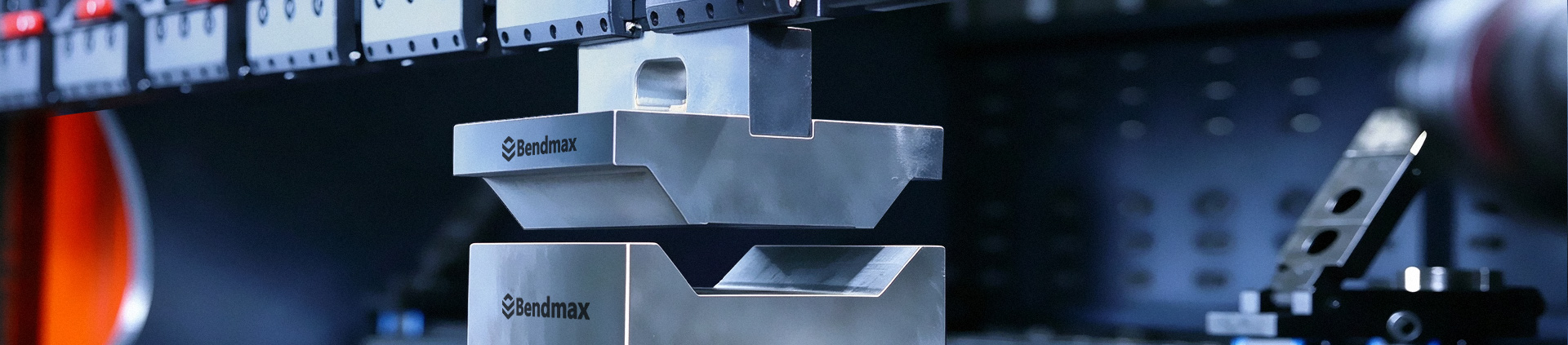
Custom tooling is not about making something unusual just for the sake of it. It is about designing a tool around a specific part geometry, material, machine, bending sequence, and production requirement when standard tooling can no longer provide the required result.
1. When Do You Actually Need Custom Tooling?
The first question is not “Can you make a custom tool?”
The better question is:
“Do I really need one?”
If a standard punch and die can produce the required bend safely and consistently, there is usually little reason to reinvent the tooling.
Custom tooling becomes worthwhile when standard tools create problems such as:
• The required bend geometry cannot be achieved
• The flange is too short or too deep
• The workpiece interferes with the standard punch
• Several bends need to be produced in one setup
• A special radius or angle is required
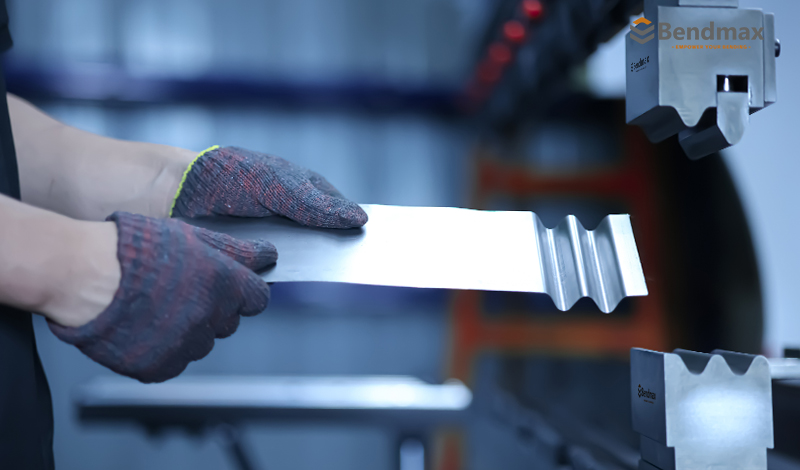
• The part requires offset or Z-bending
• Standard tooling causes marking or deformation
• The production process requires a dedicated forming operation
• Setup time needs to be reduced
• The same special part is produced repeatedly
• The workpiece must be completely free of tool marks.
In other words:
If the part is unusual, the tooling may need to be unusual too.
2. Custom Tooling Starts With the Part, Not the Tool
A common mistake is to start the discussion with:
“We need a special punch.”
That is a little too early.
A proper custom tooling design starts with the workpiece.
The tooling designer needs to understand:
Material
Typical information includes:
Material grade
Thickness
Tensile strength
Yield strength
Surface condition
For example, bending 1.5 mm aluminum and 10 mm high-strength steel are obviously not the same job. The tooling geometry, die opening, punch radius, and required bending force can be completely different.
Part Geometry
Important dimensions include:
Overall part dimensions
Flange lengths
Bend angles
Inside bend radii
Offset dimensions
Holes and cutouts
Embossed or formed areas
Clearance requirements
Even a small feature can determine whether a standard tool will work.
Machine Information
The tooling must also match the press brake.
Important machine parameters include:
Press brake manufacturer and model
Maximum tonnage
Bending length
Tooling system
Punch holder type
Die holder type
Maximum tooling height
Clamping method
Available daylight
A beautifully designed custom punch is not very useful if it does not fit the machine.
"
For more information, explore our related articles.
[ How to Calculate Press Brake Tonnage for Different Tooling (Complete Guide 2026) ]
[ How to Select the Right Press Brake Tooling Based on Bending Force ]
[ What is Press Brake Tooling? The Ultimate Guide for Manufacturers ]
3. The Most Common Custom Press Brake Tools
Custom Tooling can take many forms. Some are completely unique, while others are essentially modified versions of standard tooling.
Here are several common examples.
Custom Punches
A custom punch may be required when a standard punch interferes with the workpiece.
Typical designs include:
Extra-deep gooseneck punches
Narrow punches
Extended punches
Special-angle punches
Radius punches
Offset punches
Custom forming punches
Multi-step forming punches
For example, a deep box-shaped workpiece may collide with a standard straight punch. A gooseneck or offset punch can provide the additional clearance needed to complete the bend.
4. Custom Dies
The same principle applies to lower tooling.
A standard V die works well for conventional air bending, but special applications may require:
• Custom V openings
• Multiple V openings
• Asymmetric V dies
• Offset dies
• Radius dies
• U-shaped dies
• Four-way dies
• Adjustable dies
• Forming dies
The die opening is particularly important because it affects the relationship between material thickness, inside radius, bending force, and minimum flange length.
For conventional air bending, a commonly used starting point is:
V ≈ 6–8 × material thickness
But this is not a universal rule. Material strength, desired radius, tooling geometry, and machine capacity all matter.
That is exactly why custom tooling should be designed around the actual application rather than simply copying a dimension from a catalog.
5. When One Tool Can Replace Several Tools
Here is one of the biggest advantages of custom tooling:
You can sometimes turn several operations into one.
Imagine a part that normally requires:
Standard bending
Tool change
Offset bending
Tool change
Final forming
A specially designed forming tool may combine several of these operations into a single setup.
That can reduce:
Tool change time
Machine setup time
Operator handling
Positioning errors
Production variability
For high-volume production, even saving 30 seconds per part can become significant.
For example, at 500 parts per month:
0.5 min × 500 = 250 minutes
That's more than 4 hours of production time saved every month.
And that is just from one small improvement.
6. Custom Tooling for Mark-Free Bending
Surface marking is another common reason for going custom.
Standard V dies can leave marks on:
Stainless steel
Aluminum
Pre-painted sheet
Decorative panels
Powder-coated parts
High-visibility surfaces
If cosmetic quality is important, a custom no-mark or non-marking die may be a better solution.
Depending on the application, the tooling may use:
Polyurethane inserts
Special rollers
Replaceable inserts
Modified die geometry
Low-friction contact surfaces
The goal is simple:
Bend the sheet without leaving a tool-shaped souvenir behind.
This can be especially valuable when the finished component cannot be polished, repainted, or otherwise reworked after bending.
Bendmax Adjustable Rotatable V-die
Bendmax Round-Bar No-Mark Press Brake Die
Bendmax Wing Bending Plus tooling
Bendmax PU Holder and Insert markfree/no-mark dies
Bendmax Protective Film
Bendmax Rotatable V-die
7. Custom Tooling for Z-Bending and Offset Bending
Offset bending is another classic custom-tooling application.
A Z-bend typically requires two parallel bends with a controlled offset between them.
You can perform the operation using multiple standard tools, but a dedicated Z-bending tool can sometimes make the process faster and more consistent.
The key dimensions are usually:
Material thickness
Offset height
Bend angle
Flange length
Inside radius
Required clearance
For repeated production, a dedicated offset tool can make much more sense than repeatedly setting up several standard punches and dies.
8. Hemming and Flattening: Another Special Case
Hemming looks simple.
It isn't always.
A typical hemming process involves first bending the sheet and then flattening the folded edge.
Depending on the material and part design, the process may require:
Hemming punches
Flattening punches
Flattening dies
Spring-loaded tooling
Hydraulic flattening tools
Custom forming tools
The tooling must provide enough clearance for the pre-bent flange while controlling the final flattened geometry.
For production parts with a consistent hemming requirement, custom tooling can help reduce setup complexity and improve repeatability.
9. Materials Matter More Than You Might Think
The same custom tool design cannot necessarily be used for every material.
Consider three common materials:
Material
Typical Characteristics
Tooling Consideration
Mild Steel
Relatively easy to form
General-purpose tooling often works
Stainless Steel
Higher strength and springback
Higher force and suitable radii may be required
Aluminum
Soft surface, lower density
Surface protection and suitable radii are important
High-strength steels require even more attention.
As material tensile strength increases, the required bending force generally increases as well. Tooling must therefore be checked against the machine's available tonnage and the tooling's allowable load.
This is one reason why simply making a tool “stronger” is not the complete answer.
Tool geometry, material, heat treatment, and machine capacity all work together.
10. What Is Custom Tooling Made From?
For industrial press brake tooling, material selection is critical.
A commonly used material is 42CrMo4 / 42CrMo alloy steel, particularly for tooling that requires a good combination of strength, toughness, and wear resistance.
Depending on the application, manufacturers may also use materials such as:
C45
42CrMo4
H13
SKD11
Heat treatment is equally important.
A custom tool may use:
Through hardening
Induction hardening
Laser hardening
Localized hardening
Surface treatments
For example, a tooling design may use a hardened working area around HRC 54–60, depending on the material grade, manufacturing process, and application requirements.
The important point is that hardness should not be considered independently.
A tooling component that is extremely hard but too brittle is not necessarily a better tool.
Strength + toughness + wear resistance = the real goal.
11. Custom Does Not Mean “Made From Scratch Every Time”
This is worth mentioning.
A custom tool does not necessarily mean designing every dimension from zero.
In many cases, the best solution is a modified standard tool.
For example:
Standard punch + modified nose radius
or
Standard V die + custom insert
or
Standard holder + custom forming section
This approach can reduce manufacturing time and cost while still solving the customer's specific bending problem.
It is often a smarter solution than designing a completely new tooling system.
12. How Custom Tooling Is Designed
A professional custom tooling project normally follows a process something like this:
Step 1 — Understand the Application
Start with the part drawing, material, thickness, bend requirements, and production volume.
Step 2 — Check the Machine
Confirm the press brake model, tonnage, tooling interface, clamping system, and available working height.
Step 3 — Analyze the Bending Process
Determine the bending sequence, required V opening, punch geometry, inside radius, clearance, and estimated bending force.
Step 4 — Develop the Tool Design
CAD modeling can be used to check:
Workpiece clearance
Tool interference
Forming geometry
Tool strength
Machine compatibility
For more complex applications, FEA (Finite Element Analysis) can also be used to evaluate stress distribution and deformation.
Step 5 — Manufacture and Heat Treat
The tool is machined, heat treated, ground, and finished according to the required tolerances.
Step 6 — Test the Tool
The final step is not simply:
“Looks good. Ship it.”
The tooling should be tested against the intended application whenever practical.
The final goal is a tool that works on the actual machine with the actual material and actual part geometry.
Related Articles
" [ How to Select the Right Press Brake Tooling Based on Bending Force ]
[ Why Does Bendmax Focus on Strict Process Control During Press Brake Tooling Production? ]
13. How Much Does Custom Tooling Cost?
There is no universal price.
A simple modified punch may cost only slightly more than a standard tool.
A large, multi-stage forming tool can be significantly more expensive.
Cost depends on factors such as:
Tool size
Tool material
Geometry complexity
Machining requirements
Heat treatment
Grinding tolerance
Surface treatment
Quantity
Testing requirements
But the purchase price should not be the only number you look at.
Think about the total production cost.
If a $500 custom tool eliminates several setup operations and saves 10 minutes per batch, its value can be much higher than its purchase price suggests.
That is why custom tooling should be evaluated based on ROI, not just unit price.
14. When Custom Tooling Is Probably Not Worth It
Custom tooling isn't always the answer.
If you only need to produce 10 parts once, spending heavily on a dedicated forming tool may not make economic sense.
A standard punch and die might be perfectly adequate.
Custom tooling becomes more attractive when:
The part is produced repeatedly
Setup time is significant
Standard tools cannot achieve the geometry
Quality requirements are high
Labor costs are significant
Multiple operations can be combined
Tooling needs to remain consistent across production runs
In short:
If you bend it once, standard tooling may win.If you bend it 10,000 times, the calculation changes.
15. What Information Should You Send Your Tooling Manufacturer?
If you want a custom tooling quotation, don't just send:
“I need a special punch.”
That leaves a lot of room for guessing.
A much better starting package includes:
1. Part drawing
Preferably a PDF, DXF, or 3D CAD file.
2. Material
For example: S235, S355, stainless steel 304, aluminum 5052, etc.
3. Material thickness
For example: 2.0 mm, 3.0 mm, 6.0 mm.
4. Bend requirements
Include angle, radius, flange length, offset, and other critical dimensions.
5. Press brake information
Machine manufacturer, model, tonnage, and bending length.
6. Tooling system
European/Promecam, American, Trumpf, WILA, Amada, or another interface.
7. Production requirements
Tell the manufacturer whether you need 5 pieces, 500 pieces, or 50,000 pieces.
That last number can significantly influence the best tooling solution.
16. Custom Tooling Is Really About Solving a Production Problem
The best custom tooling isn't necessarily the most complicated one.
Sometimes it is a sophisticated multi-stage forming tool.
Sometimes it is simply a modified punch with 5 mm more clearance.
Sometimes a custom insert solves the problem.
And sometimes, after looking at the application, the best answer is:
“You don't actually need custom tooling. This standard tool will do the job.”
That's exactly what you want from a tooling manufacturer.
The goal isn't to sell you the most complicated tool.
The goal is to find the simplest, safest, and most economical tooling solution that produces the required part consistently.
Standard press brake tooling is the starting point for most bending applications.
But when your part geometry gets complicated, production volumes increase, surface quality becomes critical, or standard tools simply cannot provide enough clearance, custom press brake tooling can turn a frustrating bending operation into a much cleaner process.
At Bendmax, custom tooling can be developed for different press brake tooling systems, machine interfaces, materials, bend geometries, and production requirements.
Whether you need a modified punch, special V die, Z-bending tool, hemming tool, no-mark die, or a completely customized forming solution, the best place to start is not with the tool.
Start with the part.
Send the drawing, material, thickness, machine information, and bending requirements.
We'll work backward from the finished part to the tooling that makes it happen.



 Phone: (0086)-15002165198
 Email: jason@bendmax.com
 Wechat: Privacy Policy
 IPv6 network supported


 English


