



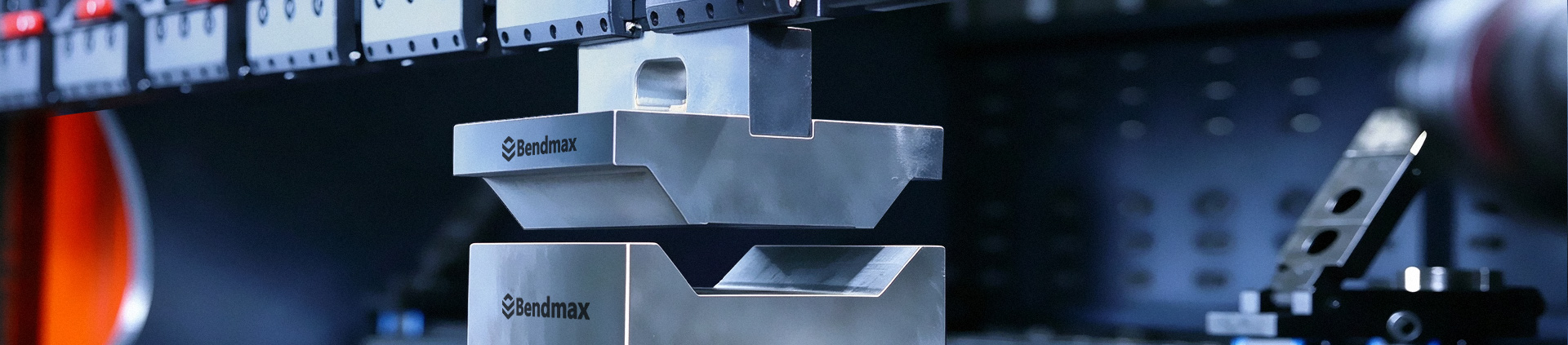
Selecting the correct press brake tooling is essential for achieving precise and stable sheet metal bending results. Even with advanced press brake machines, incorrect tooling selection can cause serious problems such as bending angle errors, surface marks, material cracking, or excessive tool wear.
Many sheet metal manufacturers understand their product design but are uncertain about which punch and die combination should be used. This guide provides a clear and practical tooling selection method used by professional fabrication engineers worldwide.
The tooling selection process can be simplified into the following steps:
|
1-Determine material type and thickness 2-Machine Tonnage and Bending Force 3-Tooling Material and Surface Hardness 4-Select the appropriate V-die opening 5-Choose the correct punch geometry 6-Confirm bending radius requirements 7-Check minimum flange length 8-Decide between standard or custom tooling 9-Set up Efficiency and Quick-Change Systems
|
Following these steps helps manufacturers select tooling that ensures accurate bending angles, reduced material stress, and longer tool life.
Material properties significantly affect bending behavior.
Different materials require different bending considerations:
| Material | Bending Characteristics |
|---|---|
| Mild Steel | Standard bending properties |
| Stainless Steel | Higher strength and springback |
| Aluminum | Softer but sensitive to surface marks |
About Material
The K-Factor is a design parameter used to estimate how much a sheet metal part will stretch during bending. It defines the ratio between the neutral axis and the total sheet thickness. While it’s primarily a manufacturing value, understanding its role allows designers to better anticipate dimensional changes after bending.
K factor varies based on material properties (ductility and strength), inside bend radius relative to sheet thickness, bending method, and tooling precision.
Recommendations for K Factor:
The table below shows recommended K-factors for the most common sheet metal materials and bending techniques.
Sheet metal often tries to regain its original shape when the bending or punching force is released. This affects the dimensional accuracy of the parts and should be compensated for during the design. Springback effects depend on the material properties and bend radius.
Design-Focused Strategies to Compensate Springback
Springback Compensation Formula
An approximate formula to estimate springback angle (Δθ):
Δθ = (K x R) / T
Where:
Accurate flat pattern design depends on understanding how sheet metal behaves during bending. Two key values help calculate precise unfolded lengths:
Bend Allowance (BA)
Bend Allowance is the arc length of the bend as measured along the neutral axis. It quantifies the material that will be “used up” in the bend.
Bend Allowance Formula:
BA = A × (π / 180) × (R + K × T)
Where:
Bend Deduction is the amount subtracted from the total length of the flanges to get the correct flat pattern.
Bend Deduction Formula:
BD = L1 + L2 − (BA + inside bend)
Where:
Design Tips:
Keep Wall Thickness Uniform
The thickness of the sheet metal directly impacts the bend radius and other critical bending parameters, such as V-opening, bending force, and flange length. Understanding this relationship is crucial for ensuring the quality and durability of the bend.
Maintaining uniform wall thickness ensures consistent bending behavior and prevents issues such as deformation, warping, or cracking.
Design Tips:
Material thickness is the key parameter for calculating V-die opening size and punch radius.
2 -Machine Tonnage and Bending Force
Every press brake has a maximum tonnage limit, and every tool requires a certain amount of force to bend a given material. Using incorrect tooling can damage both the machine and the tool.
To calculate the required tonnage (T) for air bending:
T = (k × S² × L) / V
Where:
k = material constant (1 for mild steel)
S = sheet thickness (mm)
L = bending length (m)
V = V-opening width (mm)
Check your machine’s tonnage chart or manufacturer’s guide to ensure compatibility.
The material of the tooling itself affects its strength, wear resistance, and accuracy.
Common materials include:
42CrMo (42CrMo4): Standard tool steel with good toughness.
SKD11 / D2 steel: High hardness and wear resistance.
Hardened tool steel with HRC 55–60: Long service life for mass production.
Surface treatments like nitriding or chrome plating help reduce friction and prevent rust. Investing in high-quality materials may cost more upfront, but it saves money through longer tool life and consistent performance.
The V-die opening (V) determines the bending force and internal bending radius.
A widely used rule in sheet metal fabrication is:
V = 6–10 × material thickness (T)
For most mild steel bending operations, the Rule of 8 is commonly applied:
V ≈ 8 × T
| Material Thickness (T) | Recommended V-Die Opening |
|---|---|
| 1 mm | 6 – 8 mm |
| 2 mm | 12 – 16 mm |
| 3 mm | 18 – 24 mm |
| 4 mm | 24 – 32 mm |
| 6 mm | 48 – 60 mm |
| 8 mm | 64 – 80 mm |
Using an incorrect V-die can lead to excessive tonnage, poor bending accuracy, or material deformation.
The upper punch determines the bending angle and whether interference occurs during forming.
Straight Punch
Used for standard sheet metal bending.
Gooseneck Punch
Provides clearance for box bending and deep parts.
Acute Punch (30°)
Used for acute angle bending or pre-hemming operations.
Radius Punch
Used when a controlled bending radius is required.
Selecting the correct punch geometry prevents collisions between the tool and the workpiece.
If standard moulds cannot meet your bending requirements, then you may need to consider custom moulds.
The bend radius plays a critical role in ensuring structural integrity and avoiding cracks. A too-small radius can overstress the material, especially with thicker or less ductile metals (316L or 7075). Larger radii improve formability and reduce springback, especially for materials like stainless steel and aluminum.
Design Tips:
Typical industry recommendations:
| Material | Minimum Radius |
|---|---|
| Mild Steel | R ≥ T |
| Stainless Steel | R ≥ 1.5T |
| Aluminum | R ≥ 2T |
A Z-bend involves two parallel bends in opposite directions, creating a Z-shaped profile.
Z-bends (offset bends) require a minimum vertical step height to accommodate the lower tool during bending. It depends on factors like material thickness, die slot width, and the specific bending process used and avoids tooling collisions or material distortion.
Design Tips:
Using a punch radius smaller than the recommended value may cause material cracking during bending.
The flange length must be long enough to rest on the die shoulders during bending.
A commonly used formula is:
Minimum flange length ≈ 0.77 × V-die opening
Example:
If V = 20 mm
Minimum flange ≈ 15 mm
If the flange is too short, the sheet may slide into the die opening and cause inaccurate bends.
Most bending applications can be completed using standard press brake tooling, such as:
straight punches
gooseneck punches
standard V-dies
multi-V dies
However, complex parts may require custom tooling, including:
hemming tools
offset bending tools
corrugating tools
embossing tools
Custom tooling allows manufacturers to produce complex geometries more efficiently.
In today’s competitive manufacturing world, downtime is expensive. Quick-change press brake tooling systems—such as WILA or Rolleri—allow operators to switch tools in minutes, rather than hours.
Benefits of quick-change tooling:
Faster setup time
Reduced operator fatigue
Higher accuracy through self-alignment
Ideal for short-run, high-mix production
If your shop performs frequent changeovers, upgrading to a precision-ground, quick-clamping system will dramatically improve throughput and efficiency.
Improper tooling selection often leads to production problems such as:
inconsistent bending angles
surface scratches on stainless steel
excessive bending force
premature tool wear
difficulty forming complex shapes
Selecting the correct tooling helps eliminate these issues and ensures stable production quality.
Incorrect tooling selection may lead to several production problems:
inaccurate bending angles
material cracking
surface scratches on stainless steel
excessive tonnage requirements
shortened tooling life
Using a structured tooling selection method allows manufacturers to maintain consistent production quality and reduce downtime.
Selecting the correct press brake tooling can be simplified by using several commonly accepted engineering formulas. These rules allow operators and engineers to quickly estimate the correct tooling configuration for most sheet metal bending applications.
Below are the most commonly used calculation methods in the sheet metal fabrication industry.
The recommended V-die opening (V) is usually determined based on material thickness.
V = 6 – 10 × Material Thickness (T)
For most mild steel bending applications, the commonly used rule is:
V ≈ 8 × T
Material thickness = 3 mm
Recommended die opening:
V ≈ 3 × 8 = 24 mm
Recommended die:
V24 die
The flange must be long enough to rest on the die shoulders during bending.
Minimum Flange Length ≈ 0.77 × V
If V = 24 mm
Minimum flange length:
0.77 × 24 ≈ 18.5 mm
This means the flange should be at least 18–19 mm for stable bending.
The approximate bending force required can be estimated using the following simplified formula.
Tonnage (kN/m) = 1.42 × σ × T² / V
Where:
σ = tensile strength of material
T = sheet thickness
V = die opening
For mild steel bending:
Approximate tonnage ≈ 8 × T² (per meter)
Example:
3 mm steel
8 × 3² = 72 tons per meter
The punch radius should be selected based on material type and thickness.
| Material | Recommended Radius |
|---|---|
| Mild Steel | R ≈ 1 × T |
| Stainless Steel | R ≈ 1.5 × T |
| Aluminum | R ≈ 2 × T |
Using a punch radius that is too small may cause material cracking during bending.
Press brake punches are typically produced in standard angles to allow proper springback compensation.
Common punch angles include:
30° punch – acute bending and hemming preparation
60° punch – medium angle bending
85° punch – special applications
88° punch – standard 90° air bending
The 88° punch + 78° die combination is widely considered the industry standard for 90° bending.
Part specification:
Material: Mild steel
Thickness: 4 mm
Required bend: 90°
Recommended tooling configuration:
Punch: 88° punch with R4 radius
Die: V32 die (8 × thickness)
Bending method: air bending
This combination provides a stable bending angle and balanced forming force.
Although these formulas provide a quick estimation, complex parts often require professional tooling analysis.
Bendmax engineers can assist customers by:
analyzing part drawings
recommending punch and die combinations
designing custom tooling solutions for complex bending applications
This ensures reliable bending performance and improved production efficiency.
The most common rule is V = 8 × material thickness, often referred to as the Rule of 8.
An 88° punch allows compensation for material springback and helps achieve accurate 90° bending angles.
Gooseneck punches are used when bending box shapes or deep profiles, where a straight punch would interfere with the workpiece.
Yes. Multi-V dies allow operators to select different V openings for various material thicknesses.
If you are unsure which tooling configuration is best for your application, Bendmax engineers can help analyze your part drawings and recommend the most suitable press brake tooling solution.
 Phone: (0086)-15002165198
 Email: jason@bendmax.com
 Wechat: Privacy Policy
 IPv6 network supported
leave a message
Scan to wechat :

Scan to whatsapp :

 English


