




Press Brake Crowning System: Why the Compensation Table Is Essential
A detailed look at how the compensation table improves long-part bending accuracy, minimizes angle deviations, and ensures consistent results across Wila, Amada, and Trumpf-style crowning systems.
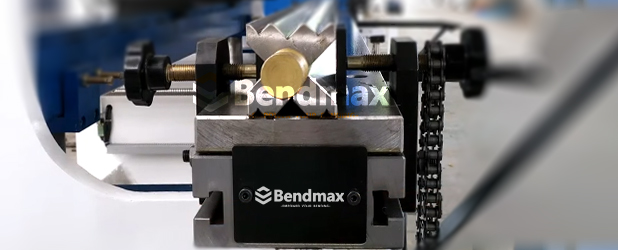
In sheet metal bending, precision is of vital importance. However, when bending long workpieces, bending machines often encounter a common problem: deflection. Under high tonnage, both the slide and the worktable may undergo slight deformation, resulting in different bending angles at the middle and the ends of the workpiece. This leads to inconsistent angles, which directly affects the quality of the product.
The bending machine compensation system (also known as the compensation table) precisely plays a role here.
A high-quality Press Brake Crowning System is an important auxiliary system, designed to compensate for the deflection during the bending process and ensure that the angle of the workpiece is uniform throughout its entire length. Without the compensation table, the deflection of the slide and the worktable would cause the middle angle to open wider and the end angles to close smaller. The compensation system is precisely designed to address this issue.
Mechanical crowning compensation systems usually consist of a set of adjustable wedge blocks or wedge mechanisms. These wedges move relative to each other to adjust the shape of the worktable, compensating for machine deformation caused by bending forces. By adjusting the position of the wedges, a counter-deformation force is applied during bending to offset the errors generated during actual operations.
Mechanical crowning compensation is typically divided into manual and automatic types, each with its own advantages and disadvantages, suitable for different applications.
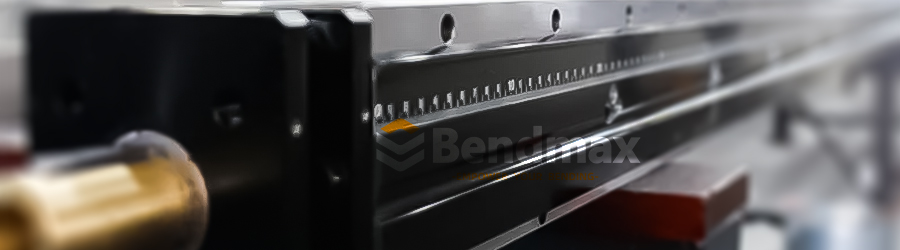
Manual Mechanical Crowning Compensation
Working Principle: Manual mechanical crowning compensation adjusts the shape of the worktable by manually adjusting wedges or other mechanical components to compensate for deformation during the bending process. Operators manually rotate adjustment mechanisms based on processing needs and experience, moving the wedges to the appropriate positions for compensation.

Advantages:
Low Cost: Manual adjustment devices are simple, with lower manufacturing and maintenance costs.
Easy Operation: The structure is relatively simple, easy to understand and operate, suitable for beginners and small businesses.
Disadvantages:
Low Adjustment Precision: Manual adjustment relies on the operator’s experience and skills, resulting in lower precision, which is challenging for high-precision requirements.
Low Efficiency: The manual adjustment process is time-consuming, affecting production efficiency, especially when frequent adjustments are needed.
Poor Adaptability: Unsuitable for scenarios requiring quick workpiece changes and process parameter adjustments.
Suitable Scenarios
Small Batch Production: Suitable for small-scale production without frequent adjustments.
Low Precision Requirements: Ideal for bending tasks with low precision demands.
Limited Budget: Suitable for small businesses with budget constraints.
Automatic Mechanical Crowning Compensation
Working Principle: Automatic mechanical crowning compensation uses CNC systems or other automatic control devices to monitor and adjust the position of wedges in real-time. After inputting the required compensation parameters, the system automatically controls the adjustment mechanism to ensure bending precision.

Advantages:
High Precision: The automatic control system can achieve high-precision compensation, meeting high-precision processing needs.
High Efficiency: The automatic adjustment process is fast and stable, enhancing production efficiency, suitable for mass production.
Good Consistency: The automatic system provides stable and consistent compensation effects, reducing human error.
Disadvantages:
High Cost: The automatic compensation system is complex, with higher manufacturing and maintenance costs.
High Technical Requirements: Requires professional operators and maintenance personnel, increasing training and management costs.
Suitable Scenarios:
Mass Production: Suitable for large-scale production requiring frequent adjustments.
High Precision Requirements: Ideal for bending tasks with high precision demands.
High Automation Needs: Suitable for highly automated and efficient production environments.
Benefits of Mechanical Compensation with Precise Effectiveness and Multi-Point Crowning
Reduces Deformation: Counteracts worktable and slider distortion from applied
forces, ensuring consistent bending angles and enhanced machining accuracy.
especially for long and varied workpieces.
Improves Precision: Multi-point mechanical crowning allows independent
adjustments across the worktable's length, precisely managing deformation in each
section for superior straightness and uniformity in extended workpieces.
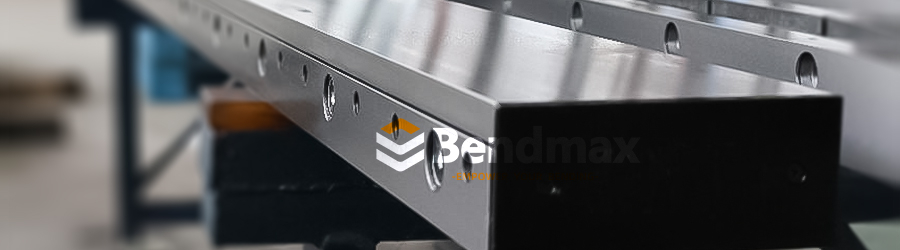
Hydraulic crowning – Some press brakes come from the factory with hydraulic crowning already built in. Hydraulic crowning uses hydraulic cylinders located in the bed of the machine. As the cylinders are filled with hydraulic pressure, they exert an upward force on the bed of the machine to compensate for deflection. Modern hydraulic crowning systems often feature what is known as dynamic crowning. Dynamic crowning provides a unique benefit of monitoring inconsistencies and resistance during the bending process, allowing for it to make real time adjustments to correct not only inconsistencies in the press brake but inconsistencies in the material as well.
Note:Unless your press brake has a hydraulic crowning system, a mechanical crowning system will probably be the solution you need to compensate for deflection.
|
|
Mechanical Crowning System |
Hydraulic Crowning System |
|
Structure |
Wedge-based mechanical design |
Hydraulic cylinders integrated into the table |
|
Adjustment Method |
Manual or semi-automatic |
Fully automatic, CNC-controlled |
|
Adjustment Speed |
Slower |
Fast and responsive |
|
Precision Stability |
Very stable; no hydraulic influence |
High consistency but affected by oil temperature/pressure |
|
Compensation Range |
Moderate; suitable for standard lengths |
Large range; ideal for long and thick plates |
|
Automation Level |
Low to medium |
High; works seamlessly with CNC |
|
Maintenance |
Low maintenance; simple structure |
Higher maintenance; potential hydraulic leaks |
|
Cost |
Lower initial and operating cost |
Higher equipment and maintenance cost |
|
Reliability |
Long service life; fewer failures |
Reliable but more components involved |
|
Best Application |
Conventional press brakes, cost-sensitive users |
High-end CNC machines, precision and mass production |
Without a compensation table, the bending angle of long parts is usually larger in the middle and smaller at both ends. However, with a compensation table, the entire bending line can be kept uniform and precise.
For operators using a modern CNC press brake machine, the camber correction system is not merely an additional device, but a necessary solution for achieving precise bending.
 Phone: (0086)-15002165198
 Email: jason@bendmax.com
 Wechat: Privacy Policy
 IPv6 network supported
leave a message
Scan to wechat :

Scan to whatsapp :

 English


