



FAQs
Press brake tooling quality must be carefully inspected to ensure dimensional accuracy, hardness stability, and consistent bending performance. Key parameters such as angles, radii, heights, straightness, and overall dimensions are verified throughout the manufacturing process.
Professional manufacturers use advanced inspection equipment to maintain high precision. These include profile measuring instruments for contour verification, coordinate measuring machines (CMM) for precise dimensional measurement, and height gauges for checking critical tooling dimensions.
In addition, straightness measuring tools are used to inspect the linear accuracy of long tooling sections, ensuring uniform bending angles along the entire length of the tool.
Bendmax performs comprehensive quality inspections using professional measuring equipment, including profile measuring instruments, coordinate measuring machines (CMM), height gauges, and straightness measurement tools. These methods help ensure tooling tolerances of up to ±0.02 mm, providing reliable accuracy in demanding bending applications.
To further enhance customer confidence, Bendmax can provide inspection reports and maintain quality traceability throughout the production process, ensuring consistent tooling performance and dependable product quality.
Segmented press brake tooling consists of multiple shorter tool sections instead of one continuous tool. This design provides greater flexibility and efficiency in sheet metal bending operations.
Segmented tooling allows operators to avoid interference with formed workpieces, making it easier to perform complex bends such as box bending or parts with return flanges. It also improves setup efficiency, since individual segments can be quickly rearranged to match different workpiece lengths.
Another advantage is better handling and installation. Shorter tool segments are easier and safer to install compared with long solid tools, reducing setup time and improving workplace safety.
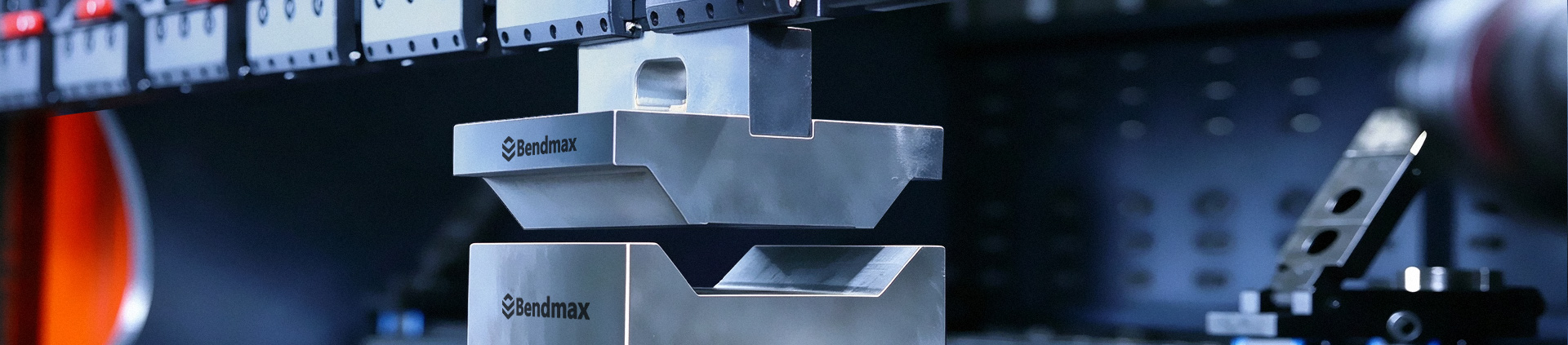
Bendmax segmented press brake punches are designed for flexibility and precision in sheet metal bending. Each punch features left and right ears for secure positioning and quick installation. The modular design allows segments to be combined to achieve the required bending length, supporting connectable lengths such as 835 mm, 415 mm, 100 mm, 50 mm, and custom sizes upon request.
Common segments of the commonly used bending machine system:press brake punch :100(Left ear),10,15,20,40,50,200,300,100(Right ear)=835mm,press brake die:10,15,20,40,50,100,200,400=835mm,
Modular length :835+415=1250mm,835+835+415=2085mm,835+835+835+415=2505mm,835+835+835+835=3340mm,835+835+835+835+835=4175mm
Bendmax segmented punches provide a reliable, flexible, and high-precision solution for complex bending operations, including box bending, interference-free bends, and multi-length fabrication.
Protecting the surface of press brake tooling is essential to extend tool life and maintain consistent bending quality. Several methods can be used to reduce wear and protect the tooling surface during production.
First, proper heat treatment and surface hardening improve the hardness and wear resistance of the working area. Induction hardening can increase the surface hardness to HRC 54–60, allowing the tooling to withstand repeated high-tonnage bending operations.
Second, precision grinding and smooth surface finishing help reduce friction between the tooling and sheet metal, preventing premature wear and surface damage.
In addition, sandblasting treatment, which is widely used by leading international manufacturers, can further enhance tooling surface performance. Sandblasting helps provide anti-scratch protection and relieves internal machining stress, improving the stability of the tool and reducing the risk of deformation during long-term use.
Bendmax applies controlled sandblasting processes to tooling surfaces, improving scratch resistance and helping maintain consistent performance throughout the tooling life cycle.
Proper operation and maintenance, such as selecting the correct V-die opening and using appropriate bending tonnage, also contribute to extending the service life of press brake tooling.
Tooling quality plays a critical role in determining the accuracy, consistency, and surface quality of sheet metal bending. Even when using a high-precision press brake, poor-quality tooling can lead to angle deviation, inconsistent bends, premature wear, or surface marks on the workpiece.
High-quality press brake tooling must meet strict requirements in material selection, heat treatment, machining precision, and grinding accuracy. These factors ensure that the punch and die maintain stable dimensions and hardness during repeated high-tonnage bending operations.
Bendmax press brake tooling is manufactured through a controlled 12-step manufacturing process, including designing, material selection, body hardening, milling, deep hardening, sandblasting, grinding, cutting, quality control, laser marking, packaging, and delivery.
As a result, Bendmax tooling helps manufacturers achieve stable bending angles, consistent production quality, and longer tooling service life, even in high-volume sheet metal fabrication.
Professional press brake tooling usually has a tool body hardness of HRC 30–35, while the working surface hardness reaches HRC 54–60 after induction hardening. Bendmax maintains this hardness balance to provide both toughness and long service life.
 Phone: (0086)-15002165198
 Email: jason@bendmax.com
 Wechat: Privacy Policy
 IPv6 network supported
leave a message
Scan to wechat :

Scan to whatsapp :

 English


